
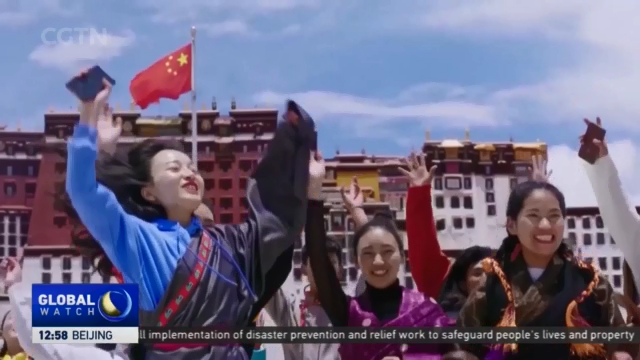
In southwest China's Xizang Autonomous Region, boarding school education has opened doors for children growing up in some of the country's most remote areas. In today's episode of Boarding on Hope, CGTN's Huang Yue meets Dekyi Chodron, a young Tibetan entrepreneur who returned to rural Xizang after studying abroad.
No stage lights, and no professional performers…
This is a field music festival held at nearly 3,900 meters above sea level in rural Xizang.
On stage are local villagers.
Many of them are folk artists and cultural inheritors from the region.
Moving through the crowd and serving tea is Dekyi Chodron, a young Tibetan entrepreneur.
Much of her work revolves around preserving traditional culture and serving rural communities.
DEKYI CHODRON Tibetan Entrepreneur "I'm from Ngari. I went to elementary school in Ngari. Apart from when I was at school, I spent time in pastoral areas with my grandparents. I really love the place with that kind of rustic warmth. I think the sense of human connection there is something nowhere else can match."
Ngari is one of the highest regions in Xizang, where the average altitude reaches 4,500 meters.
For children growing up in remote pastoral areas like hers, access to quality education was once a challenge.
But boarding schools, even far from home, have brought better opportunities.
DEKYI CHODRON Tibetan Entrepreneur "For me, boarding life has always been a natural choice. We ate and studied together. And those friendships are still very strong today. Without those good educational policies, I wouldn't be where I am now. I started boarding school at 11 years old, and that's when I started to see a much broader world. Since then, I already started seeing so many different things."
Dekyi later pursued her master's degree at the University of Strathclyde in the United Kingdom.
There, she says, she encountered stereotypes about where she came from.
DEKYI CHODRON Tibetan Entrepreneur "They asked things like, 'Are you completely oppressed by policies'? 'Since you came out, are you not planning to go back?' Just questions like that. Most of the questions are about policies. Most of them act as if we're being raised in a cage with no human rights and no freedom. Ever since I was a child, I've always felt that people look at us through a filter."
And that's one of the reasons she decided to return home after graduation.
She felt that if she wanted people to better understand Xizang, she should start by contributing to it herself.
DEKYI CHODRON Tibetan Entrepreneur "If I want to do a good job promoting Xizang's culture and art, I need to truly put down roots here. Only after rooting myself here can I really call myself a cultural worker."
Back in Xizang, Dekyi and her team began working with local communities.
One focus of their work is helping traditional culture find new audiences.
That often means traveling from village to village, meeting artisans and folk artists whose skills have been passed down for generations.
DEKYI CHODRON Tibetan Entrepreneur "This is a custom-made boot for a Tibetan opera troupe, over seventy pairs in total, and they were just sent off. The order brought in about 24,000 US dollars in income for five tailors in the workshop. Look, this is what they look like."
Another elder Dekyi has been visiting is a master of traditional Tibetan folk songs.
In the past, these songs were passed down orally, from one generation to the next.
Today, his lyrics have been compiled and published, preserving them in written form.
DEKYI CHODRON Tibetan Entrepreneur "People look at Xizang through different lenses, whether good or bad.
But for us young people living here, especially those of us in the culture and tourism industry, this is the modern side, the fashionable side.
It's something we can fully vouch for and proudly show to the outside world.
We are confident to say that big cities like Beijing, Shanghai, and Guangzhou are good, but Xizang has its own greatness too."
Dekyi choosing her path reflects a new generation of Xizang: well educated, outward-looking, and deeply rooted.
Driven by the profound love for their hometown, and a determination to change long-held stereotypes, these young Tibetans return not just with new ideas, but with concrete actions, helping the region move forward.
Huang Yue, CGTN, Chundui Township, Xizang Autonomous Region.