
In southwest China's Xizang Autonomous Region, teaching has never been limited to the classroom. For decades, scattered villages, vast distances, and harsh terrain meant teachers often traveled with herdsmen during seasonal migrations. In this episode of Boarding on Hope, our reporter Huang Yue follows the journey of a veteran teacher to understand how boarding schools have transformed education in remote areas.
About an hour and a half's drive northeast of Lhasa, the capital of Xizang, lies Nimajiangre Township. Its name, translated from Tibetan, means "the garden of sunlit willows."
With an average altitude of 4,200 meters, the township is home to fewer than 10,000 people. Here, just one primary school provides all six grades, and it operates as a boarding school.
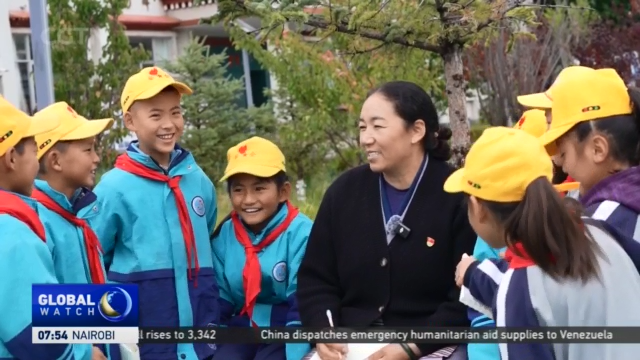
At about eleven in the morning, the campus is at its liveliest. Running alongside the children is Thondup Drolma, a teacher with 33 years of experience. She has been honored as a National Model Teacher recently, one of China's highest honors for educators who have devoted themselves to frontline teaching over decades.
THONDUP DROLMA, Teacher, Nimajiangre Township Central Primary School "I came to this school in 1999. Back then, there were only about ten teachers. As for students, it was 270 or 260. I can't remember exactly, but it was over 200. The school moved to this new location in 2005. Then it gradually expanded. Starting from 2021, the number of students has already exceeded a thousand."
Living at a boarding school, students have all their meals on campus. Many are very young, especially in the lower grades, and are still learning basic life skills. For headteachers like Thondup Drolma, the responsibility extends far beyond the classroom. She accompanies students to the cafeteria, ensuring they eat well, waste less food, and clean up afterward. The school also provides free, nutritious snacks between classes as part of China's nationwide nutrition improvement program for rural primary schools.
Born and raised in this area, Drolma knows better than most how geography shapes education here. Scattered villages, winding mountain roads, and long distances make daily commuting unrealistic for many families.
THONDUP DROLMA, Teacher, Nimajiangre Township Central Primary School "Villages here in Xizang are not concentrated. They're all in mountain valleys. Some valleys only have two or three households. If parents come to drop off their children every morning and come to pick them up every evening, they would spend their whole day tied up with the children. They can't get anything else done. The roads are also bad, and it's easy for accidents to happen."
Drolma's day doesn't end when classes do. In the evening, she makes rounds in the dormitories. For younger students, she even helps them wash up and make their beds.
THONDUP DROLMA, Teacher, Nimajiangre Township Central Primary School "The difference between a head teacher and other teachers is that the head teacher has to go around the dorms every night. We check whether students can manage their bedding, whether they are dressed properly. We stay until we see if the kids have fallen asleep or if anyone can't sleep. And if a student gets sick, the head teacher handles that too."
Her career began in 1992 at a village teaching point deep in the mountains, with just one small building and 17 students. The single room served as a classroom during the day and a dormitory at night. The village teaching point no longer exists, but Drolma takes us to where it once stood. What pained her most was watching students drop out. Because she could only teach up to Grade Three, most families chose not to send their children farther away for continued schooling. Here, Drolma unexpectedly meets the mother of a former student.
Thondup Drolma: Her eldest daughter used to be my student.
Reporter: What does she do now?
Thondup Drolma: She stays at home.
Reporter: Did she continue school after Grade Three?
Thondup Drolma: No, she didn't.
The woman explains that her eldest daughter couldn't move far from home due to health issues and stayed behind to herd livestock. Her younger daughter, however, attended a township boarding school, went on to university, and is now an experienced insurance agent. Two daughters, two very different paths. For this Tibetan mother, the contrast reinforced a simple belief: education changes lives. Today, even in the most remote corners of Xizang, few children drop out of school because of distance or cost. Boarding schools have become a key solution for students from remote pastoral and farming areas.
Huang Yue, CGTN, Nimajiangre Township, Xizang Autonomous Region.