
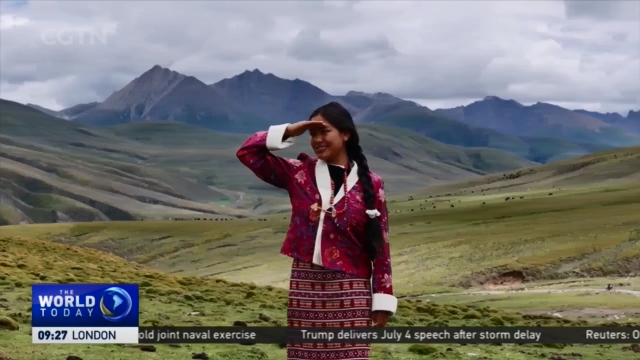
From the high mountains of southwest China's Xizang Autonomous Region, opportunities can seem distant. But for a young girl from a herding family in Nagqu, China's highest-altitude prefecture-level city, boarding school has opened the door to a future full of promise. In this episode of our five-part series Boarding on Hope, our reporter Huang Yue traces the journey of Pema Lhamo.
High in the mountains of northern Xizang sit a village perched at nearly 4,000 meters above sea level.
A rare celebration lights up the rugged landscape.
Relatives gather, offering white khata, a traditional Tibetan scarf that conveys best wishes.
Pema Lhamo receives their congratulations.
She has been admitted to the China University of Petroleum, one of the nation's top universities.
She is the first child here to attend a university of this stature.
PEMA LHAMO College Freshman "The night the results came out, I was still working at a construction site. It was raining heavily. I was a bit nervous on my way home. I kept checking the website. Other regions already released their results. But Xizang hadn't. It seemed like Xizang was a bit later. I kept waiting. Then late at night, China University of Petroleum came through. I was overjoyed."
Lhamo was born into a traditional herding family. Her father is a Buddhist practitioner. Her mother tends the yaks.
Lhamo is the youngest of six children.
Today's celebration also honors her fourth sister, Lhazom – now an exchange student at Xiamen University, another top university in the southeastern province of Fujian.
But their path to education has never been easy.
PEMA LHAMO College Freshman "We used to go to the township school. To give us a better education, my parents sold a few yaks, so we could go to school in the county. I was a boarding student."
Three years of boarding school at middle school transformed Lhamo into a confident, independent student.
She excelled academically and earned admission to a high school in Lhasa, the capital of Xizang, where she continued her boarding life.
She studied hard because she was determined to transform her family's future.
Lhamo's sister Lhazom struggles to hold back tears while talking about her younger sibling.
LHAZOM Pema Lhamo's Sister "My sister is the youngest in our family. But she has the kindest heart. She always thinks about our parents. When she got into a good university, I was even more excited than when I got into my own. I didn't cry when I got into university myself. But when she got in, I was so happy."
(Reporter: Why?)
"Because she's the youngest in our family."
With two daughters now stepping into new futures, their father, Sotse, is filled with emotion.
SOTSE Pema Lhamo's Father "When we were young, there were barely any schools here. Transportation was terrible. Only families with enough money could send a child to study, and even then, they had to walk long distances. In the whole township, maybe only one or two children could go to school."
Before leaving for university, Lhamo returned to her high school in Lhasa to thank the teachers who supported her.
The journey from her village to Lhasa takes nearly 12 hours by car.
Lhamo: Thank you so much for all your guidance these three years. Without you, I wouldn't be who I am today.
Her head teacher, Pema Yangzom, was among those who encouraged her most.
PEMA YANGZOM Teacher of Lhasa Nagqu No. 2 High School "I'm truly happy for her. Her hard work, especially in the final year, has paid off. As the head teacher, I'm very happy."
LOBSANG Vice Principal of Lhasa Nagqu No.2 High School "Many students from farming and herding families in Nagqu couldn't get access to quality education. After the establishment of this high school in Lhasa, students can have access to better education resources. And since this is a boarding school, it covers food and accommodation all for free. So the parents feel at ease, and students can really focus on their studies here."
For Pema Lhamo, the journey out of the mountains is only beginning. She carries not only her own dreams, but also the hopes of her family and her entire community.
In 2004, Xizang set up high schools in Lhasa to recruit students from extremely high-altitude regions like Nagqu and Ngari.
Such moves are believed to maximize the education rights of children from remote areas.
Huang Yue, CGTN, Xizang Autonomous Region.