
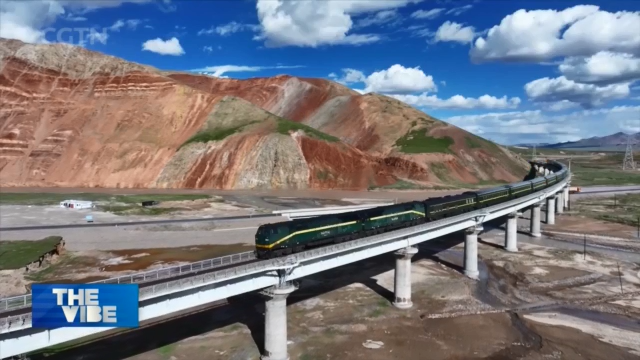
Twenty years ago, the Qinghai-Xizang Railway began operations, ending the Xizang Autonomous Region's long history without a railway connection. Since then, it has carried more than 100 million passengers and transported over 800 million tons of cargo, reshaping travel, trade, and everyday life across the plateau. Zhou Yixin reports.
Known as the "Sky Railway," the Qinghai-Xizang Railway was constructed across some of the world's most challenging terrain under extremely harsh natural conditions. It remains the world's highest railway and stands as one of the most remarkable engineering achievements ever built.
ZHOU YIXIN Tanggula Mountain Railway Station, Qinghai Province "Here is Tanggula Mountain Railway Station, the highest railway station in the world, sitting at an altitude of more than 5,000 meters. At this altitude, oxygen levels are only about half of those at sea level, or even lower. Building a railway across this plateau was once considered nearly impossible."
When the first train arrived Lhasa in 2006, it marked a historic moment for people across the region – one many still remember vividly today.
LI JIANMING Driver of the first train to Lhasa "I'll never forget the excitement in their eyes. When we arrived in Lhasa, local people gave us such a warm welcome. They draped hada scarves over the locomotive. And it wasn't just that first day – they did it on almost every train during those first few years. We didn't understand their language, but we understood how much this railway meant to them. It was deeply moving."
Reporter: Do you still remember the day the first train passed through your hometown?
GESANG CERING Resident of Xizang's Amdo County "When the first train passed through Amdo on its way to Lhasa, the whole village came out to watch it. We stood by the railway, waving and shouting, 'Welcome! Welcome!'"
That historic moment ushered in a new era for the once-isolated plateau.
Over the past two decades, the railway has fundamentally changed daily life, making travel for work, education, healthcare, and tourism significantly more accessible for local residents.
GESANG CERING Resident of Xizang's Amdo County "Before the railway, driving to Lhasa took two or three days, and even longer when it snowed. In 2006, I took the train to Lhasa, and in 2009 I traveled outside Xizang for the first time, visiting Shanghai and Hangzhou. In the past, making a trip like that was something we could hardly imagine."
WANGMO Lhasa Resident "My child first took the train when leaving for school in China's interior. Before that, we had never traveled by train."
Reporter: Where is your child studying now?
Wangmo: At the Xizang Ethnic High School in Shaoxing, Zhejiang Province.
Reporter: Why did you decide to send your child there?
Wangmo: My child wanted to go there to study.
The railway has created new opportunities not only for the people who live here, but for the region as a whole.
Daily freight train services have increased from 24 a day in 2006 to 136 today, allowing more local specialties and products from Xizang to reach wider markets across the country.
WANG LIANHE Railway Operations Manager, Golmud Railway Station "The railway once mainly brought supplies into Xizang. Today, it carries more and more locally produced goods to markets across China, supporting the region's economic development."
Twenty years on, the story of the Qinghai-Xizang Railway is still evolving.
Since the railway opened, the plateau's rail network has continued to expand, connecting more people, opening up new opportunities, and bringing the once-remote plateau closer to the rest of the country than ever before. Zhou Yixin, CGTN, Xizang Autonomous Region.