
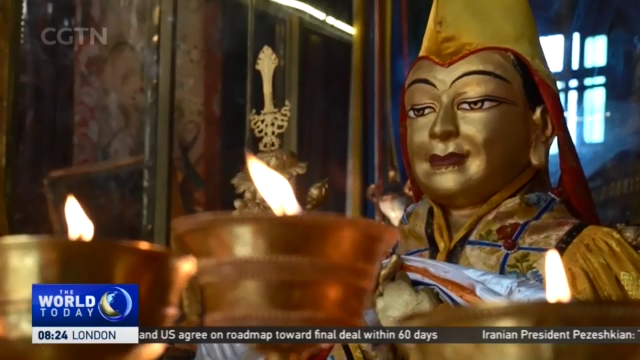
Tibetan Buddhist temples in China's Xizang region are not only sacred sites, but also rich sources of plateau culture integrating architecture, education, and social functions. Since the 1980s, the Chinese central government has allocated special funds, including gold and silver, annually for the maintenance and restoration of Tibetan Buddhist temples. Over 1-point-4 billion yuan, or about 200 million US dollars has been invested. Our reporter GUO TIANQI has more.
Let's visit the three most famous temples in Lhasa: Ganden Monastery, Drepung Monastery, and Sera Monastery. Each has its own unique features, undertaking the responsibilities of patriarchal inheritance, political and academic roles.
The Buddha Unfolding Ceremony during the summer Shoton Festival is the liveliest time at Drepung Monastery.
A huge Buddha image, approximately 42 meters long and 40 meters wide, is slowly unfolded on the hillside, receiving the admiration of believers once a year.
GUO TIANQI Lhasa, Xizang Autonomous Region "Drepung Monastery is the largest Tibetan Buddhist temple in the world. Its name means 'piling up like rice', symbolizing its prosperity."
The serene and harmonious Drepung Monastery was once the political and religious center of Xizang.
GUO TIANQI Lhasa, Xizang Autonomous Region "This is the Ganden Phodrang Palace, which was also the residence of the 2nd to the 5th Dalai Lamas. During the transition between the Ming and Qing dynasties, the Gelug school, also known as the Yellow Hats, with the support of the Mongolian leader Güshi Khan, established the Ganden Phodrang theocratic regime with the Dalai Lama as their supreme leader, which ruled from the 1640s to the 1950s."
"This is the 5th Dalai Lama. He made the greatest contributions and also directed the construction of the Potala Palace."
The 5th Dalai Lama attached great importance to relations with the central dynasty. In 1652, he was invited by Emperor Shunzhi of the Qing Dynasty to go to Beijing for an audience. He was the first to be conferred the title of Dalai Lama, which also clarified the subordinate relationship between Xizang and the central government of the Qing Dynasty.
GUO TIANQI Lhasa, Xizang Autonomous Region "The Gelug school is the most influential sector of Tibetan Buddhism. The Ganden Monastery here was built by Tsongkhapa himself, the founder of the school, and his pagoda is also preserved here."
Tsongkhapa is equivalent to a "religious reformer" and "spiritual mentor" in the history of Tibetan Buddhism. He standardized Buddhist education, exerted a profound influence on the development of Tibetan Buddhism, and is regarded by believers as the 'incarnation of wisdom and compassion'.
The pagoda is a "sacred vessel" built to commemorate his life and enshrine his relics, serving as a core site for believers to express their reverence and connect with spiritual heritage.
GUO TIANQI Lhasa, Xizang Autonomous Region "Throughout its 600-year long history, Ganden Monastery has maintained close ties with the Ming and Qing dynasties. The gifts from the central government can still be admired by today's visitors and pilgrims."
For example, the complete set of Kangyur Buddhist scriptures and thangkas from the Ming Dynasty all demonstrate the close ties between the central and local authorities.
Tsongkhapa's sleeping hall is still open to the public for visits and worship. Being tapped on the head with Tsongkhapa's scripture is meant to enhance wisdom.
Sera Monastery is located in downtown Lhasa, famous for its Buddhist logic and the tradition of debating scriptures. The debates in this debating ground have lasted for 600 years.
It is also one of the famous temples where many Tibetan Buddhist monks hope to come for exchanges and studies.
"My monastery is in Aba, Sichuan Province. I have come twice, the last time when I was 18, and this time at 42."
For pilgrims, Sera Monastery has two interesting traditions. One is to pass under the scripture storage pavilion to pray for wisdom and safety, and the other is to worship Hayagriva, a unique deity in Tibetan Buddhism, who is believed to have the effect of calming people's minds and bringing peace.
The sound of scriptures echoes, and the golden roofs shine. The good wishes of Tibetans and other ethnic groups for a happy life continue to be passed on with white hadas.
Guo Tianqi, CGTN, Lhasa, Xizang Autonomous Region.