
This year marks the 75th anniversary of Xizang's peaceful liberation. One of the first cities liberated was Qamdo in eastern Xizang. Reporter Chen Mengfei travels there to retrace that history and see what the region looks like today.
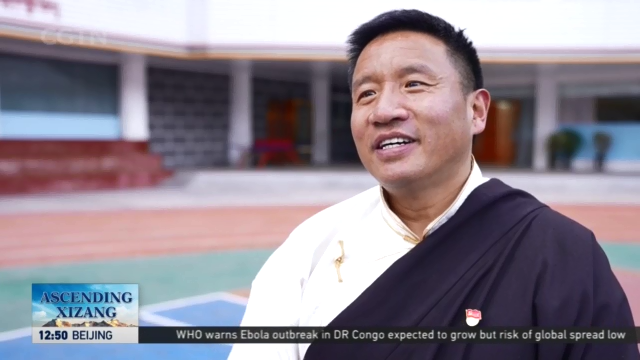
This is Qamdo Experimental Primary School.
These third-graders are curious and extremely friendly to a visiting reporter who's there for their school's unique history.
CHEN MENGFEI Qamdo City, Xizang Autonomous Region "When it opened in 1951, it marked a watershed moment. This was the first modern school in Xizang."
Today, Xizang is often associated with breathtaking landscapes and spirituality.
It is easy to forget that this was once a society where around 95 percent of the population was illiterate.
GYAYONG YUANDING Party Secretary, Qamdo Experimental Primary School "At that time, only a small privileged class, the nobles and powerful families, had access to education. Ordinary people had no right to go to school."
That began to change in 1950, when the newly founded People's Republic of China moved to liberate Xizang as part of its push for territorial reunification.
CHEN MENGFEI Gangtuo Village, Qamdo City, Xizang Autonomous Region "On October 6, 1950, the 18th Army climbed over the mountain behind me from Sichuan, crossed over the Jinsha River, and entered Xizang here. It marked the beginning of the Battle of Qamdo."
The goal was to wage a short yet decisive campaign, to pressure local authorities to the negotiating table.
And the battle of Qamdo achieved just that.
Within weeks, the PLA secured a victory.
Seven months later, the peaceful liberation of the whole of Xizang was signed into agreement.
TSE SHA Former Party Secretary of Aila Village, Gangtuo Township, Qamdo "The biggest changes are that we now have running water, paved roads, and electricity."
Tse Sha was born in 1963, 13 years after his village became the first place to be liberated in Xizang.
Today, his hometown is quietly prospering, with local monks running grocery stores and driving sedans.
In another town in the Qamdo region, the memory of the 18th Army runs through a family of doctors.
Tibetan physician Drang Song is the son-in-law of a former 18th Army soldier.
LOSONG SONAM Director of Ritong Tibetan Medicine Hospital, Qamdo, Xizang Autonomous Region "When I was six years old, my father showed this medical box to me and said this belonged to my grandfather."
His grandfather's name was Li Yuanlang.
He came to Xizang from Chongqing, as a young medic in the troops.
Like so many of his peers, he stayed, built roads and bridges, started a family, and never left.
Today, his grandson, Losong Sonam, runs a successful business selling Tibetan medicine across China.
He uses a significant portion of the profits to help families in the area who cannot afford major medical treatment.
Most people in Xizang are farmers and herders who make a moderate living.
To support them, the government provides a wide range of subsidies, including educational.
GYAYONG YUANDING Party Secretary, Qamdo Experimental Primary School "Students don't need to spend a single cent. All educational costs are covered through special government funding. We also provide nutritious meals every day to ensure children receive proper nutrition. The level of support is almost unimaginable."
Outside the gate of Qamdo Experimental Primary School, we met this father picking up his fifth-grader daughter.
She told us her father never had the chance to attend school himself, but she and her three older siblings all have.
Her dream is to become a lawyer one day and help people in need.
One can tell, her father is already very proud of her.
Chen Mengfei, CGTN, Qamdo City, Xizang Autonomous Region.