
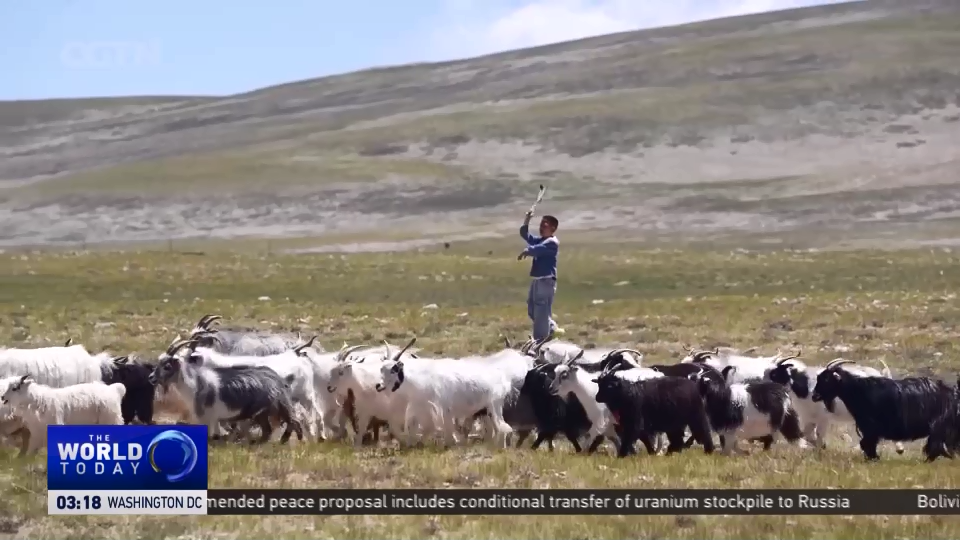
Nagqu in southwest China's Xizang Autonomous Region sits at an average altitude of over 4,500 meters, making it one of the highest cities in the country. For years, getting an education was a major challenge for local children. Today, boarding schools are helping change that. CGTN's Huang Yue follows a 13-year-old herder on his journey back to school.
This is the northern Xizang Plateau. At over 4,500 meters above sea level, the sky is so blue the clouds seem within reach. A young boy whistles as he swings a rope, guiding the flock forward. For 13-year-old Tenzin Lobsang, this has always been the rhythm of summer, simple, familiar, and rooted in the highland life he's grown up with.
TENZIN LOBSANG, Boarding School Student "I help my grandparents herd the sheep, shear wool, and milk the sheep. I like it here because it feels free. If I want to play, I play. If I don't, I just walk home."
It's the last day of summer vacation. Lobsang has to prepare for school, reviewing his lessons. He will be entering his final year of primary school. His school is located at the center of the county, about a two-hour drive from home. He lives on campus during semesters.
DAWA DROLMA, Tenzin Lobsang's Mother "We asked around and learned that Baingoin Sinopec Primary School is good. We also asked about the teachers. Everything is good there, including the food and dorms. So we chose that school."
Lobsang's mother Dawa Drolma says she and her husband work full-time. His grandparents are usually busy in the herding fields. The good schools are located far from home, therefore boarding school became the best choice.
DAWA DROLMA, Tenzin Lobsang's Mother "We feel very at ease. When he is at school, we never have to stress about anything going wrong. At parent-teacher meetings, we find out he gets one or two awards every single day, and the teachers are always praising him. As parents, that just makes us really happy."
TENZIN LOBSANG, Boarding School Student "By boarding at school, I want to be more independent and not rely on my parents for everything. If I kept thinking about them and calling them all the time, they would worry about how I'm settling into the dorm. I don't want them to worry."
After lunch, Lobsang's grandfather prepared to take him back to school by motorcycle. The farewell carried a touch of sadness, but their blessings were wrapped within the white khata, a traditional Tibetan scarf symbolizing good wishes.
Built in 2012 with investment from Sinopec, Baingoin Sinopec Primary School is widely known as "the aid-funded primary school that's closest to the sky."
NGAWANG WANGDU, Principal of Baingoin Sinopec Primary School "Our school has expanded from 850 students to 1,345 now. And when it comes to the school's facilities, it's not just the best in Bangoin County, but one of the best in the whole Nagqu region. You could even compare it to some schools in Lhasa."
More than half the students here board by family choice. For children like Lobsang who are from remote herding areas, boarding not only makes education possible, but also eases their parents' worries.
UDRUP TSOMO, Dormitory Administrator, Baingoin Sinopec Primary School "We have six dormitory buildings. Three for boys and three for girls. Each room has six students on average."
"What basic facilities are inside the dorms? Do you have heating in winter?"
"Yes, we do have. In summer we don't need it anyway. But now water is super convenient. We have running water. Look, shampoos, toothbrushes, toothpastes, soaps, and face cream, all of these have been distributed to students."
"All newly given out by the school?"
"Yes, all new."
Open days let parents see how their children study, live, and eat. With free meals for all students, food safety and balanced nutrition are top priorities.
NGAWANG WANGDU, Principal of Baingoin Sinopec Primary School "In addition to three meals a day, we also provide nutritional subsidies for students. So between classes, we also give them milk, bread and fruit, all carefully chosen for the students to enjoy."
Alongside Mandarin, mathematics, and English, Tibetan language studies are also a compulsory part of the curriculum. Extracurricular activities are also emphasized. Each year, the school's sponsors support around 50 students on study tours to other Chinese cities, an experience many local families consider life-changing.
Lobsang was given such an opportunity, and that trip inspired him to dream beyond the grasslands.
TENZIN LOBSANG, Boarding School Student "I visited Tian'anmen, the Old Summer Palace, and the Science and Technology Museum."
"How did you feel after visiting those places?"
"I was especially impressed by the Science and Technology Museum. It made me realize how powerful technology can be."
"Do you have any goals for yourself?"
"I want to get into a better middle school. And when I grow up, I really hope to attend the National University of Defense Technology."
"Really? Why?"
"Because when I scroll through videos online, I often see content about the university. It seems like they produce a lot of outstanding talents there. I really want to get into that university and serve in the military."
"You want to join the military? Why?"
"Because I want to protect my country."
For families living across vast grasslands and high mountain valleys, boarding schools have opened opportunities that once felt far beyond reach. And for children like Lobsang, the path ahead is no longer limited by geography or distance, but shaped by the dreams and ambitions they choose to pursue.
In old Xizang, the illiteracy rate was over 95%. By 2024, nearly 98% of students completed nine-year compulsory education, while the high school enrollment rate reached 91.56%.
Since 2012, Xizang has offered 15 years of free education, covering tuition, meals and boarding from kindergarten through high school.
Huang Yue, CGTN, Baingoin County, Xizang Autonomous Region.