
The China Disabled People's Performing Art Troupe staged its first public performance in the Xizang autonomous region on Tuesday night, nearly four decades after its founding, bringing its signature performances to the high-altitude region and sharing the stage with disabled Tibetan performers.
The troupe's performance of My Dream at the Tibet Grand Theater in Lhasa marked the first time it had performed in Xizang since its establishment 39 years ago.
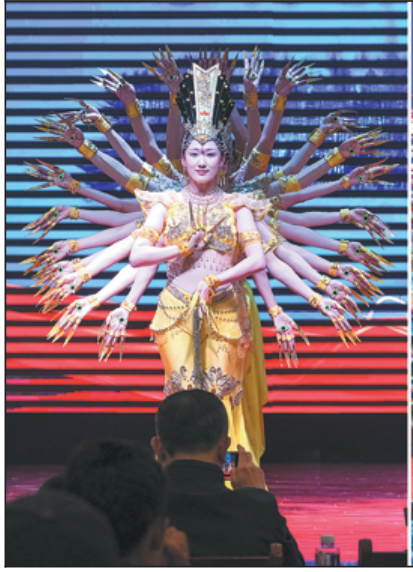
In addition to iconic dance performances such as the Thousand-hand Bodhisattva, the artistic production featured programs by local performers living with disabilities, continuing the troupe's tradition of adapting its programs to local customs and audiences.
Visually impaired Tibetan singer Karma Dechen performed the Tibetan folk song Auspicious Nine and Wine, which combines blessings with elements of traditional Tibetan drinking culture.
"I grew up listening to the song and had a strong personal connection to it, performing it in a relatively traditional folk style," she said.
She also performed a Tibetan-language version of Those Who Raised Me and Those I Raise with her daughter.
"I brought her to the performance so she could experience the event and learn from accomplished artists from the national troupe," she said.
The national troupe also prepared programs with distinct Tibetan elements for the occasion, including an instrumental medley featuring On the Golden Hill of Beijing and The Qinghai-Tibet Plateau.
Wang Jing, deputy head of the China Disabled People's Performing Art Troupe, said the troupe has performed in more than 100 countries and regions and traveled extensively across China, but Xizang had remained the only part of the country it had yet to visit.
"We had hoped to come to Xizang for many years, but the trip was postponed several times because of temporary national assignments and other reasons," Wang said.
Members of the China Disabled People's Performing Art Troupe perform during a visit to an SOS Children's Village in Lhasa, Xizang autonomous region, on Monday. JIANG FEIBO/CHINA NEWS SERVICE
The opportunity finally arose when the China Disabled Persons' Federation proposed that the troupe perform in the region ahead of the federation's conference on assistance to Xizang, which will be held from Wednesday to Thursday.
The visit not only showcased the artistic achievements of people with disabilities, but also encouraged wider participation in disability-related cultural programs, Wang said.
The performers hope to help society better understand the spirit of people with disabilities and move beyond the stereotype that they need sympathy, she added.
A day before the main performance, the troupe staged outreach performances for grassroots audiences, including children at a welfare institution in Lhasa.
Chen Jing, captain of the troupe's hearing-impaired dancers, said she was deeply moved by the children's response during the outreach performance.
The troupe hoped its songs and dances would bring warmth to people in Xizang and strengthen bonds between performers across different parts of China.
"The feeling here is different from performing overseas. It feels like we are family," Chen said in sign language.
For Yu Yu, a visually impaired erhu — a traditional Chinese musical instrument — artist who has congenital albinism, the visit held special meaning for many of the troupe's performers.
"Xizang has always been a place the troupe particularly wanted to visit," Yu said.
"The language and ethnic characteristics may be different, but the warmth in people's hearts and their love and encouragement for special art are the same," she said.
Qi Liang, deputy head of the Tibet Disabled Persons' Federation, said the performance offered a rare opportunity for people with disabilities and disability workers on the plateau to watch a major professional artistic production in person.
"The event could also help inspire people with disabilities in Xizang to build confidence, become more independent and strengthen their artistic skills," he said, adding that it aims to promote greater public attention to people with disabilities and encourage broader social participation in supporting them.