
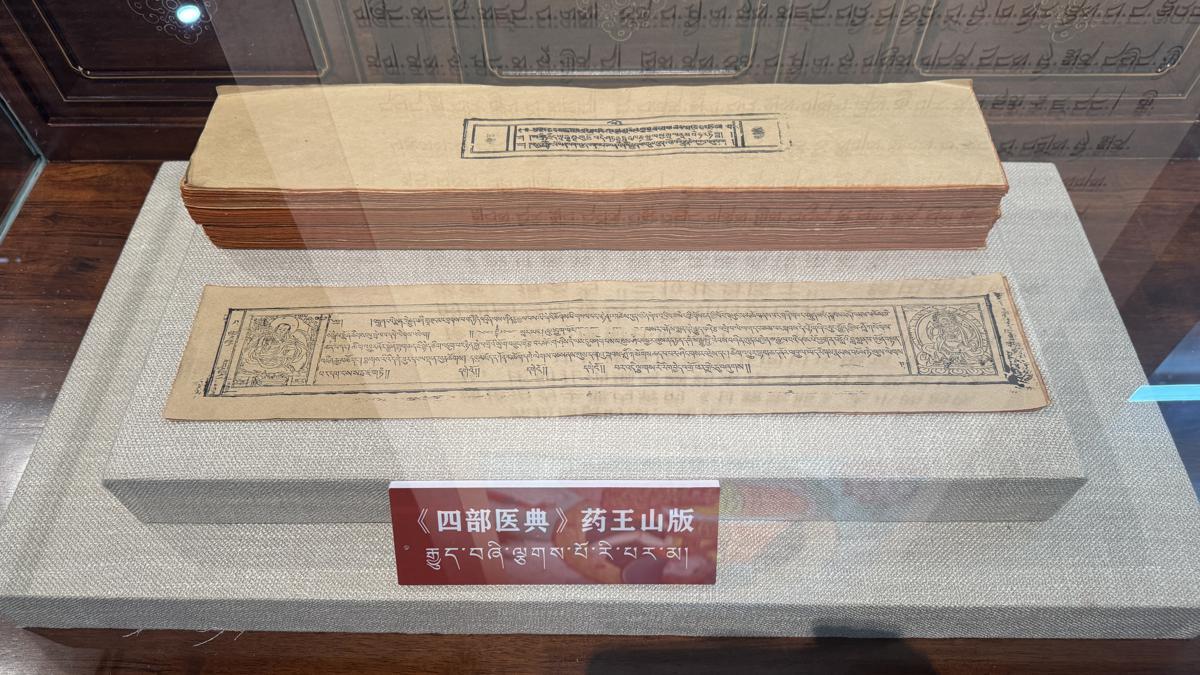
A woodblock edition of the Four Treatises of Tibetan Medicine is preserved at the Tibetan Hospital of the Xizang autonomous region. The work, compiled between the eighth and 12th centuries, was inscribed on UNESCO's Memory of the World Register in 2023 as part of a documentary collection of four woodblock editions and a gold-ink manuscript. [Photo by Guo Yanqi/chinadaily.com.cn]
Nearly 110 years after its founding, the Tibetan Hospital of the Xizang autonomous region is using modern equipment and telemedicine alongside centuries-old practices to treat chronic illnesses common at high altitudes.
The hospital was founded in Lhasa in 1916 as the Men-Tsee-Khang, an institution teaching Tibetan medicine and astronomical calculation. It became the regional Tibetan hospital in 1980 and now has 700 beds and more than 900 staff. It records more than 530,000 outpatient and emergency visits a year.
Tsering, the hospital's president, said many patients had chronic conditions affecting their cardiovascular and respiratory systems, as well as their joints.
"Many parts of Lhasa and Xizang are at high altitude, so plateau-related illnesses account for a large proportion of the patients we treat," he said. "Tibetan medicine is suited to the plateau and has been tested in practice here for more than a millennium."
Doctors primarily use Sowa Rigpa, the traditional Tibetan medical system. Its foundational work, the Four Treatises of Tibetan Medicine, was compiled between the eighth and 12th centuries and added to UNESCO's Memory of the World Programme in 2023. The medical knowledge was also illustrated through a series of 80 thangkas (Tibetan religious paintings), the president said.
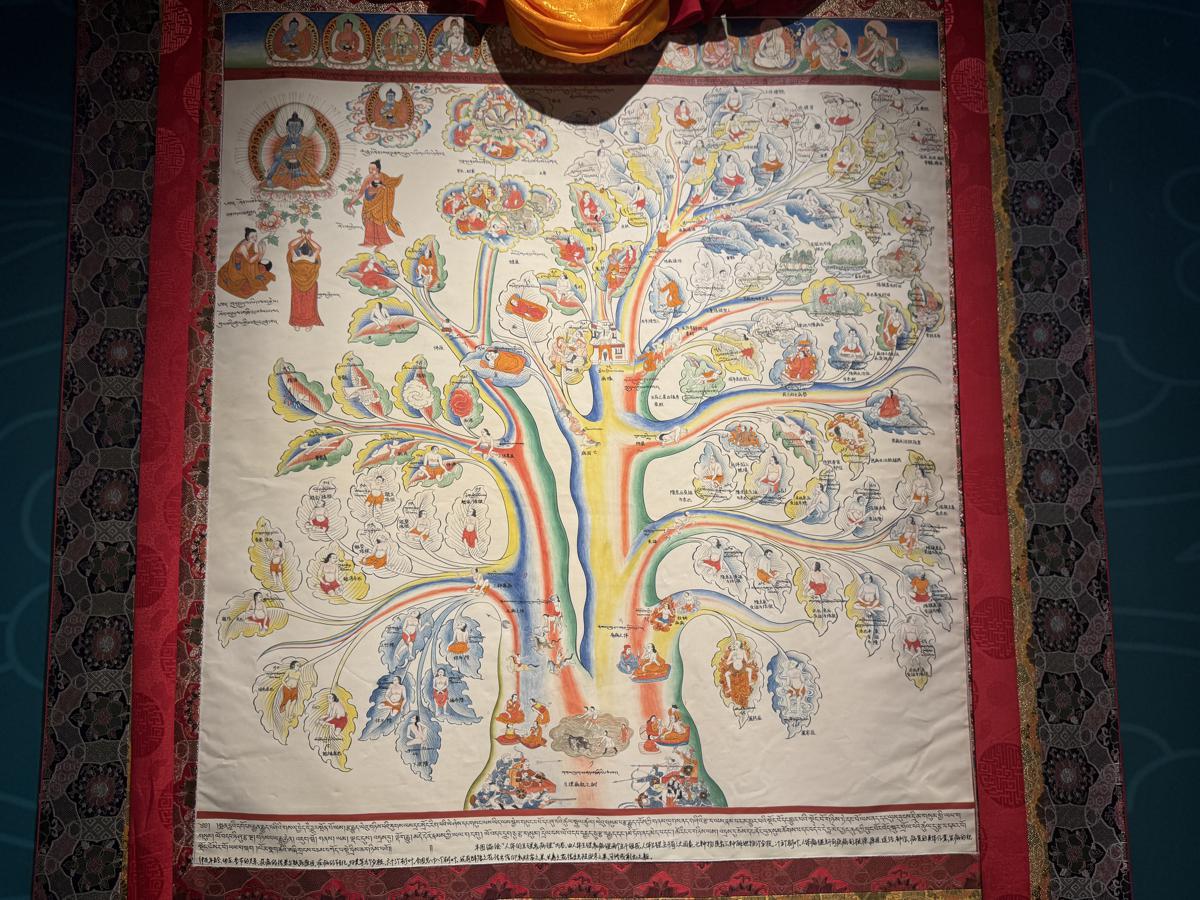
A medical thangka known as the Tree of Physiology and Pathology hangs at the Tibetan Hospital of the Xizang autonomous region. It illustrates medical knowledge in Sowa Rigpa, or traditional Tibetan medicine. [Photo by Guo Yanqi/chinadaily.com.cn]
Tsering said traditional Tibetan and Chinese medicine had different theoretical foundations but shared some treatment and healthcare techniques. The hospital uses acupuncture, while some TCM hospitals elsewhere in China have adopted Tibetan medicinal bathing. The latter was added to UNESCO's Representative List of the Intangible Cultural Heritage of Humanity in 2018.
Brazilian journalist Nelson Pancini De Sa tried Lum medicinal bathing at the hospital. He said the treatment left him refreshed and sweating, and that he found it easier to breathe at altitude.
Tsering said the hospital had adopted modern technologies to strengthen diagnostic abilities. CT and MRI scanners are used alongside traditional diagnostic methods involving observation, listening, smell, and touch.
A new telemedicine network links the hospital with Tibetan medical institutions at city and county level, as well as some township clinics. Doctors in remote areas can consult specialists online about difficult cases and arrange transfers for seriously ill patients.
In 2025, the hospital also established the China Xizang Trans-Himalaya Tibetan Medicine Research Center to support cross-regional and international research and the development of Tibetan medicine standards.