

The warm, humid monsoon winds that sweep up from the Indian Ocean don't stop at the Himalayas. They find their way through the Yarlung Zangbo Grand Canyon, the world's deepest gorge, and pour into the mountains of the southeastern part of the Xizang autonomous region.
They leave behind an extraordinary landscape that compresses several climate zones into just a few dozen kilometers of horizontal distance.
From the tropical monsoon rainforest of Metog county at 155 meters above sea level to the permanent snows of Namcha Barwa Peak at 7,782 meters, the region known as Nyingchi contains nine significant altitudinal natural zones — a "miniature Earth" that has drawn biologists and explorers for decades.
Recently, a new visitor attraction, a nature station, opened in Gongbo Park in the heart of Nyingchi. It debuted at the fifth China Xizang Trans-Himalaya Forum for International Cooperation and attracted instant attention from guests from more than 20 countries. Developed by the Chinese National Geography, the Nyingchi nature station aims to help visitors understand the landscape before them.
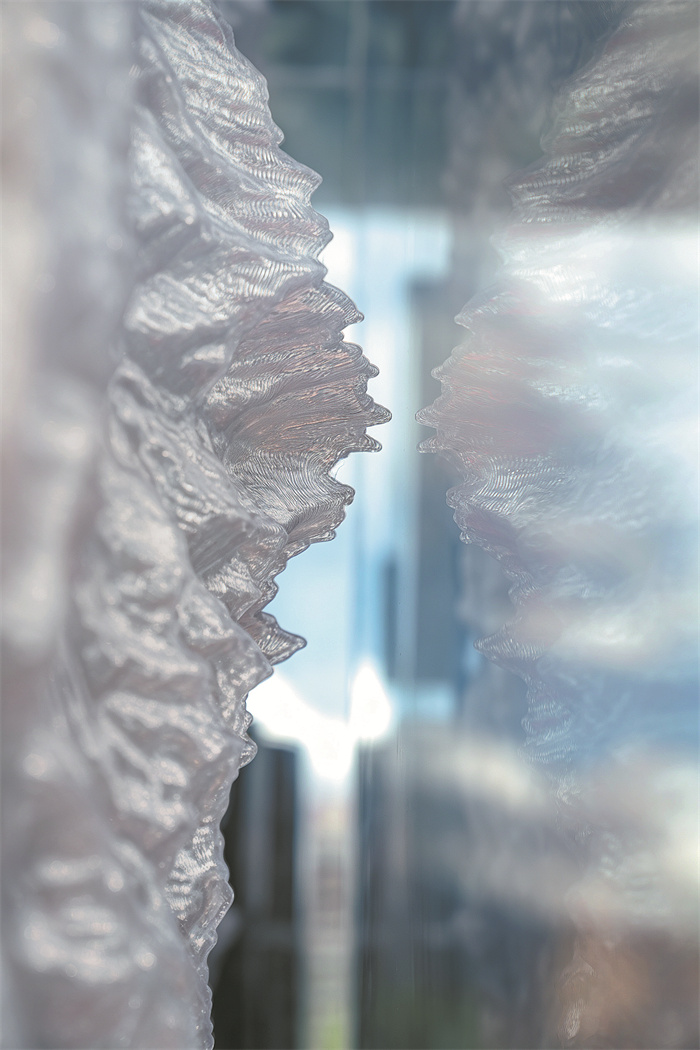
Step inside, and a 3D-printed topographic map of the Yarlung Zangbo Grand Canyon reaches waist height. Press a button, and its rivers glow blue. Pull open a drawer beside it, and you'll find profiles of the region's great peaks: the 7,782-meter Namcha Barwa, the eastern anchor of the Himalayas, and its neighbor Gyala Peri.
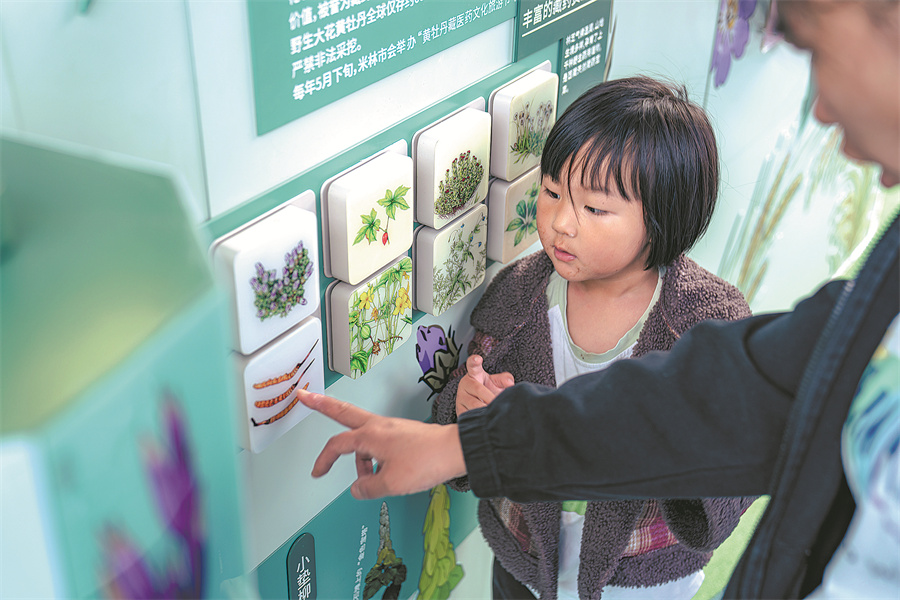
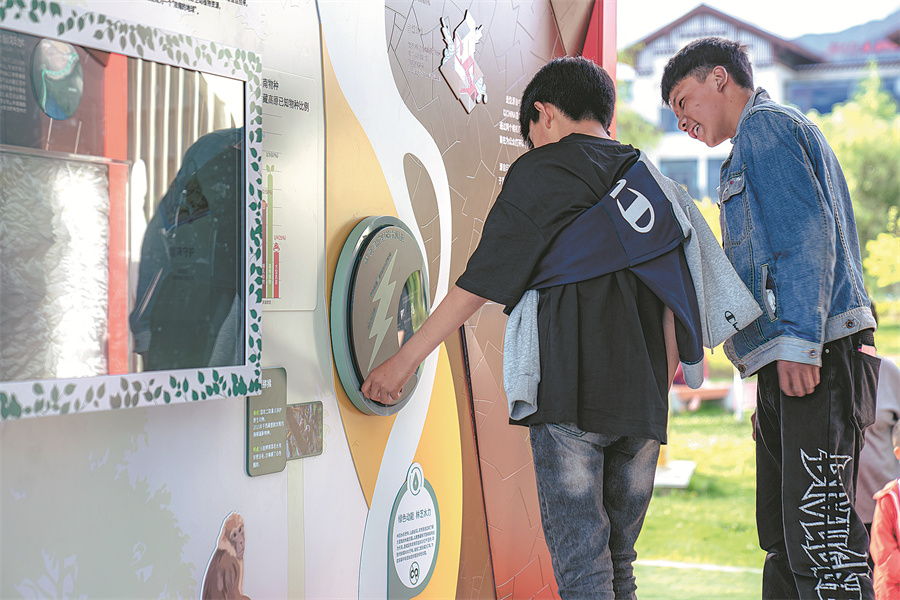
Elsewhere, visitors can spin a cylinder to watch the Asiatic golden cat transform through five color morphs. Nearby, a button triggers birdcalls that move through the forest in a "bird wave" — yellow-throated fulvettas and other birds, each playing a role as callers, followers or lookouts.
Climbing the stairs to the second floor feels like ascending 4,800 meters in elevation, from tropical monsoon rainforest to alpine scree. At the top, a viewing window frames a snowy mountain.
Guo Yingqian, general manager of the Chinese National Geography Camp, describes the station as a kind of micro-museum in nature.
"Traditional stations were places to rest," she explains. "Tourist centers are reception and display buildings for scenic areas. Our nature station resembles a compact, open structure that uses interactive installations and scientific exhibits to interpret the local natural ecology and cultural stories."
The Nyingchi station is designed as an urban installation that systematically interprets the concept of an ecological community encompassing mountains, rivers, forests, farmlands, lakes, grasslands, deserts, and glaciers.
The camp team plans to divide China into roughly 50 unique geographic units based on six natural zones and eight ecosystems, and establish nature stations or centers in each.
"Nyingchi is in southeastern Xizang and has the world's most complete natural mountain vertical zones," Guo says. "The landscapes are extremely dramatic — Namcha Barwa and the Yarlung Zangbo Grand Canyon — and it's also one of the world's biodiversity hotspots. It really captures the diversity we're trying to showcase," she explains.
The station's 26 interactive exhibits follow a simple but powerful idea: a vertical ascent.
The ground level, surrounded by exhibits on Mountain, Water, and Forest elements, aims to present Nyingchi's ecological foundation.
A hand-drawn map shows how the collision of the Indian and Eurasian plates 65 million years ago created the Yarlung Zangbo suture zone, making Nyingchi one of the planet's most geologically active mountain regions.
The staircase connecting the two floors is itself an exhibit. As visitors ascend, they pass through representations of each vertical zone — from tropical monsoon rainforest below 1,100 meters to alpine scree at 4,800 meters, with animal silhouettes and interactive photo points marking each transition.
The second floor shifts focus to Farmland, Grassland, Lake, Glacier, and Sand, along with the human and ecological relationships that define life at higher elevations.
A display on rice cultivation in Metog and Zayul counties, a rotating column illustrating eight hardy meadow plants, and a section on the region's remarkable glaciers are among the highlights.
The station's true innovation lies in the small things.
For the "10 Questions About Glaciers" display, a flipboard answers questions about why glacial meltwater is not always safe to drink, as well as how glaciers have changed over recent decades.
"We're trying to take authoritative scientific knowledge and turn it into fun experiences," says Gai Yifang, a member of the station's lead design team.
"Through science-plus-art, we transform it into interactions where visitors can press buttons and listen. For tourists, it's more engaging and less like being lectured."
The team works closely with the Chinese Academy of Sciences to ensure accuracy.
Then they distill.
"For animals, we avoid long taxonomic descriptions and morphological characteristics," Gai says. "Instead, we highlight one memorable fact that visitors might find interesting — always based on scientific fact — and pair it with professional photography and scientific illustrations."
The station is powered by solar panels paired with an integrated battery storage system, enabling it to operate its lighting and interactive exhibits off the grid under normal conditions.
But the team didn't stop at the technical side. They turned nature itself into a teaching tool. Displays explain how mycorrhizal fungi lock carbon in forest soils, how serpentinite rocks absorb carbon dioxide and turn it into carbonate minerals, and how glaciers regulate global climate.
"Nature is itself a zero-carbon textbook," Gai says. "Visitors discover that zero carbon is happening around them every day."
The Nyingchi station is part of a growing national network.
In April 2024, the first nature station opened in Metog, with a bird-focused theme. Butterfly, giant tree, geology, cat, and orchid stations followed. In September 2025, four themed stations appeared in Bomi, dedicated to the region's glaciers, spruce forests, wildlife, and unique ecological systems.
Guo, general manager of the camp, says the network currently comprises 24 nature stations nationwide, with footprints in Xizang, Xinjiang Uygur autonomous region, Shenzhen of Guangdong province, Chongqing and Wuxi in Jiangsu province.
The latest addition of the Nyingchi station to this growing network plays a special role.
"Previous stations were focused on individual themes — a single species or resource type. This station, however, presents a systematic geographical narrative of Nyingchi as a whole," Guo explains.
"It provides an overarching scientific context for other Nyingchi stations."
Functionally, its central location in Nyingchi makes it an ideal first stop, giving visitors an overall understanding of the region before they venture further.
"Tourists no longer just take a photo and leave. They can follow the stations' guidance and spend more time systematically exploring the land. This helps position Nyingchi as a world-class destination for ecological and cultural tourism."