

Dancers perform at a park in Metog, Xizang autonomous region, last month. KUNGA LESANG/CHINA NEWS SERVICE
When Kelsang Dekyi traveled out of Metog county in the Xizang autonomous region via a highway tunnel through the Galongla Mountain for the first time, she did not just see light at the end of the tunnel, but a brighter future for her people.
The tunnel, a key part of the Zhamog-Metog Highway connecting Metog with neighboring Bomi county's Zhamog township, looks like a tiny wormhole against a backdrop of mountains covered in snow even in June.
"The zigzagging old roads, which are abandoned, were the only means of getting in and out of Metog," said the 48-year-old. "All people, young and old, had to make the dangerous journey that took days on foot in the old days."
Frequent natural disasters, such as avalanches, landslides and mudslides, often blocked the old roads to the county. This extreme isolation earned Metog its name, which translates to "secret lotus" in the Tibetan language, according to Kelsang Dekyi, who now serves as the vice-principal of Wanquan Primary School in Metog.
Constructing modern roads to Metog, which lies on the lower reaches of the Yarlung Zangbo River and on the southern slope of the Himalayas, represents one of the most punishing engineering challenges in China due to highly unstable geological conditions and volatile mountain weather. After several attempts were thwarted over decades, a 117-kilometer highway finally opened on Oct 31, 2013, making Metog the last county in China to be connected to the national highway network.
The breakthrough required an initial capital investment of 950 million yuan ($140 million), a massive engineering gamble that has since yielded staggering economic returns. In 2012, the year before the highway opened, Metog's local economy was largely dormant, with a GDP of just 260 million yuan. Since the road's completion, the county's GDP has grown at an average annual rate of 13.8 percent, recently crossing the historic 1 billion yuan milestone — a nearly 300 percent total economic expansion.
This macroeconomic surge has translated directly into a dramatic rise in living standards for the county's estimated 15,300 residents. The average annual disposable income for rural residents in Metog has skyrocketed by more than 400 percent, rising from 4,875 yuan in the pre-highway era to 24,935 yuan today, while urban residents now see average incomes reach 47,198 yuan.
"I can still vividly remember having to walk through knee-high snow for three days to reach Bomi when I was a child," Kelsang Dekyi, a member of the Monba ethnic group, recalled. "I don't think I could endure such trips now, and the children in my school will never need to know the hardship of those journeys."
After graduating from Hebei Normal University's Minzu College in 2001, she chose to return to Metog to become a primary school teacher to offer local children better educational opportunities.
With more locals having the chance to explore the outside world and more people coming in bringing fresh ideas since the opening of the highway, Metog's residents now understand the importance of education more than ever, she said.
"In the past, our mission was to persuade parents to send their children to school and keep them in school. Now our task is to provide them with quality education," Kelsang Dekyi said while watching students playing on a recently refurbished soccer field. "Without the highway, the school would never have top teaching facilities in place. The road has changed everything."
Even with the modern highway, the journey to Metog remains an adventure. Drivers must cross the snow-capped Galongla Mountain at an altitude of nearly 5,000 meters before descending into the Yarlung Zangbo River valley at just 800 meters. The trip takes about eight hours, provided travelers do not encounter landslides in the summer or avalanches in the winter. Because vehicles must crawl carefully along cliff-hugging lanes, traffic management authorities only allow non-local motorists to enter Metog on even-numbered days and leave on odd-numbered days to prevent accidents and jams.
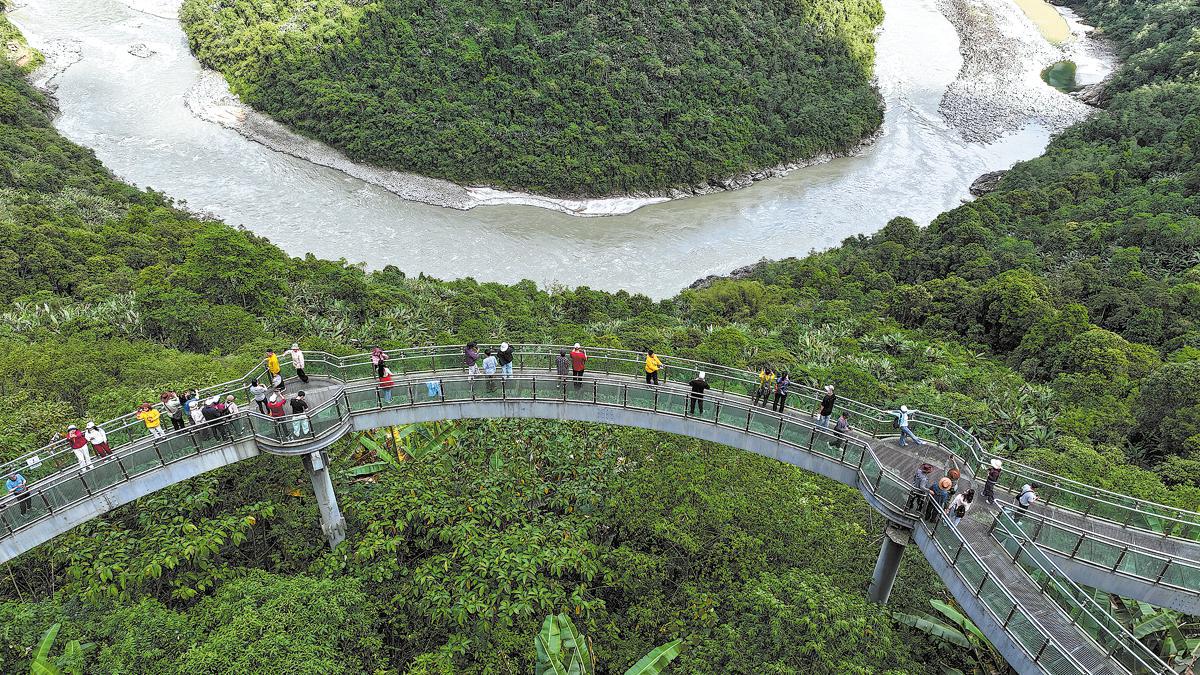
Visitors take in a panoramic view of a horseshoe-shaped bend of the Yarlung Zangbo River in Metog in May. KUNGA LESANG/CHINA NEWS SERVICE
Zhang Shuisheng, a driver who has navigated the route frequently since 2013, said it's probably the only highway in China that still needs such regulation, which shows how challenging the road is.
"Efforts to upgrade the highway have never stopped over the past decade. Getting to Metog has become much easier and safer. And the transformation of the county in such a short time is unbelievable," said Zhang.
For the people of the Monba ethnic group who live along the Yarlung Zangbo River canyon, where the snow-capped peaks give way to lush subtropical forests, the road has unlocked a viable agricultural sector.
Resident Drakpa makes a living by planting tea, bananas and other subtropical fruits on terraced fields in a village in the canyon.
"Like many villagers, I only learned to become a farmer since the road opened. What's the point of cultivating agricultural products when it's nearly impossible to ship them out?" Drakpa said.
In the past, everything, including rice, salt and medicine, had to be carried on the backs of porters, or strapped to mules trudging over icy passes to reach Metog. And things were unthinkably expensive.
Following in the footsteps of his father, Drakpa became a porter when he was just 10. "At first, I could only carry 20 kilograms of goods. And each delivery trip to and from Bomi would demand more than 10 days of strenuous effort," he said. "I thought that's what life would always be like."
Today, he simply calls a courier service to deliver his tea anywhere in China.
Metog's tea industry was born in 2011 when teams from the coastal provinces of Guangdong and Fujian arrived under China's paired assistance program and realized the local monsoon climate was ideal for cultivation. Once the highway opened, the county government was able to scale production rapidly, transforming crude stilted villages into modern settlements equipped with stable infrastructure and bringing commodity prices down to match those of the outside world.
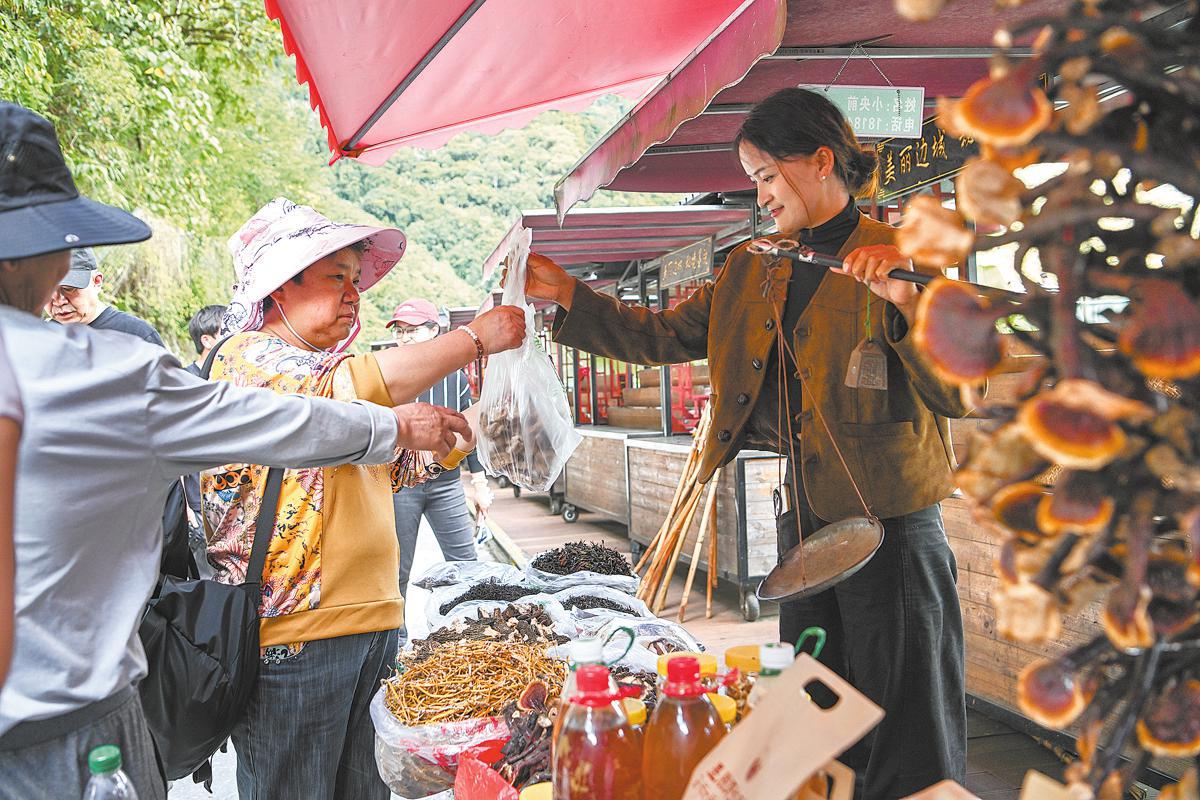
Tourists purchase local specialty products in Deshing township of Metog in May. KUNGA LESANG/CHINA NEWS SERVICE
Beyond agriculture, tourism has become a new driver of the local economy, with Metog attracting over 700,000 visitors annually and generating 470 million yuan in tourist revenue. The county's unique altitude drop offers a condensed view of the Earth's diverse climates, packed with glaciers, rivers and rainforests. While Metog had barely one functional hotel a decade ago, dozens of modern lodgings and national hotel chains now operate at full capacity during holidays.
"It's like compressing the landscapes around the world into one county, earning Metog the nickname 'Condensed Earth'," driver Zhang said. "Often, the hotel rooms are all fully booked during national holidays."
Tondring from Gelin village works as a guide taking tourists to see the 76.8-meter Bhutan pine, which is one of the tallest trees found on the Chinese mainland.
"I knew the tree was tall when I was a child, but I didn't know it was that tall until the scientists measured it in 2022. It has become the top tourist attraction in the village," said Tondring, who previously made his living from hunting.
Besides taking tourists to see the tree, Tondring said he also enjoys sharing with them lessons in the biodiversity of the forest. "The knowledge I gained from being a hunter now can help me better protect the wildlife," he said.
He said an increasing number of tourists now choose to stay at the homestays in the 28-household village, so they can enjoy the unique and stunning scenery of tea farms against the backdrop of Mount Namcha Barwa.
"Without roads in good condition and access to 5G networks, we wouldn't be able to attract so many tourists," Tondring said.
With the extra income from being a guide, he made a trip to Beijing two years ago and visited Tian'anmen Square — his dream tourist destination. "I would never plan the trip if the highway didn't open. I think it has made many impossible things possible."