
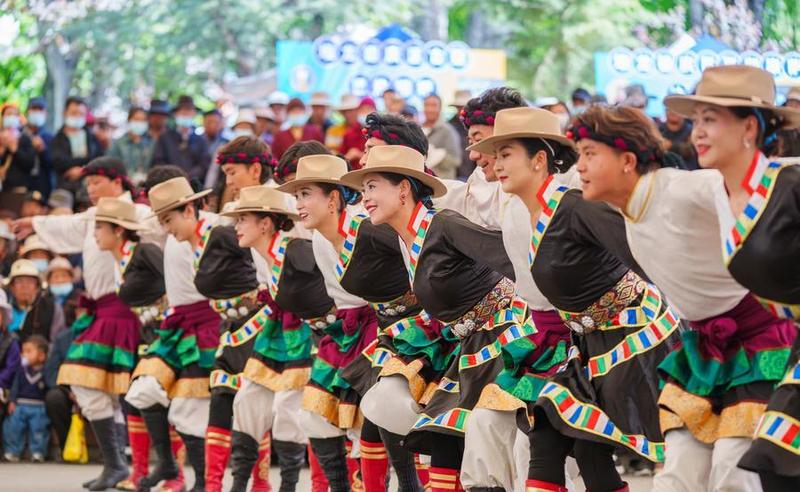
This photo taken on May 22, 2026 shows a scene of an event marking the 75th anniversary of the peaceful liberation of Xizang in Lhasa, Southwest China's Xizang autonomous region. [Photo/Xinhua]
A symposium marking the 40th anniversary of the China Tibetology Research Center was held in Beijing on Tuesday, with officials and scholars calling for stronger Tibetan studies and high-level think tank development to support long-term stability, high-quality development and international communication related to Xizang.
At the opening ceremony of the symposium, Li Ganjie, a member of the Political Bureau of the Communist Party of China Central Committee and head of the CPC Central Committee's United Front Work Department, said the center has played a leading role in Tibetan studies since its founding 40 years ago. It has united scholars in the field and enriched work related to Xizang in the country, building an independent Chinese knowledge system for Tibetan studies, strengthening academic communication and improving the research landscape.
He said Tibetan studies have gained importance as Xizang and Tibetan-inhabited areas in the provinces of Sichuan, Yunnan, Gansu and Qinghai are at a key stage of pursuing high-quality development and achieving long-term stability. He called for deeper theoretical work, greater strategic awareness, improved international communication, better integration of research resources and stronger talent development.
Zheng Dui, director-general of the China Tibetology Research Center, said in a work report that the center was founded in Beijing, on May 20, 1986, with the mission of serving national unity, ethnic solidarity, and bringing development and stability to Xizang and Tibetan-inhabited areas in the four other provinces. Over the past four decades, the institute has evolved to become a leader in the field of Tibetan studies, Zheng said.
He said the center has upheld the guiding role of Marxism, promoted the development of national high-level think tanks, advanced the building of an independent Chinese knowledge system for Tibetan studies, strengthened academic exchange platforms and improved research mechanisms and talent training.
Zhao Rui, vice-president of the Chinese Academy of Social Sciences, said Tibetan studies and the development of national high-level think tanks on Xizang-related issues should treat the forging of a strong sense of community for the Chinese nation as their foundation. He called for a new research paradigm for Tibetan studies in the new era and for greater efforts to improve international understanding of Xizang through academic research.
Speakers at the symposium said Tibetan studies should not be confined to academic research; it should instead provide intellectual support for governance, development, ecological protection and border-area stability. They also emphasized the need to improve the translation of research findings into policy advice and international communication.
Several scholars said building an independent Chinese knowledge system for Tibetan studies is central to the field's future development. They called for stronger interdisciplinary and cross-regional research, deeper study of historical documents, and more attention to real issues concerning Xizang's development and governance.
Hu Yan, a professor at the Party School of the CPC Central Committee, said misunderstandings and bias in the West on Xizang-related issues cannot be overcome overnight, and that long-term academic work is needed to clarify facts and improve global understanding.
Other speakers highlighted the center's major academic achievements, such as the publication of the Tibetan-language collated edition of the Chinese Tripitaka, A General History of Xizang and the Tibetan-language volume of The Chinese Encyclopedia. They said these works have laid an important foundation for building a Chinese system of knowledge in Tibetan studies.
More than 100 officials, scholars and representatives from central departments, Xizang, Tibetan-inhabited areas, universities, research institutions and media organizations attended the symposium.
Participants said the 40th anniversary marks a new starting point for Tibetan studies in China, with greater emphasis on academic innovation, think tank development, talent training and international communication.