
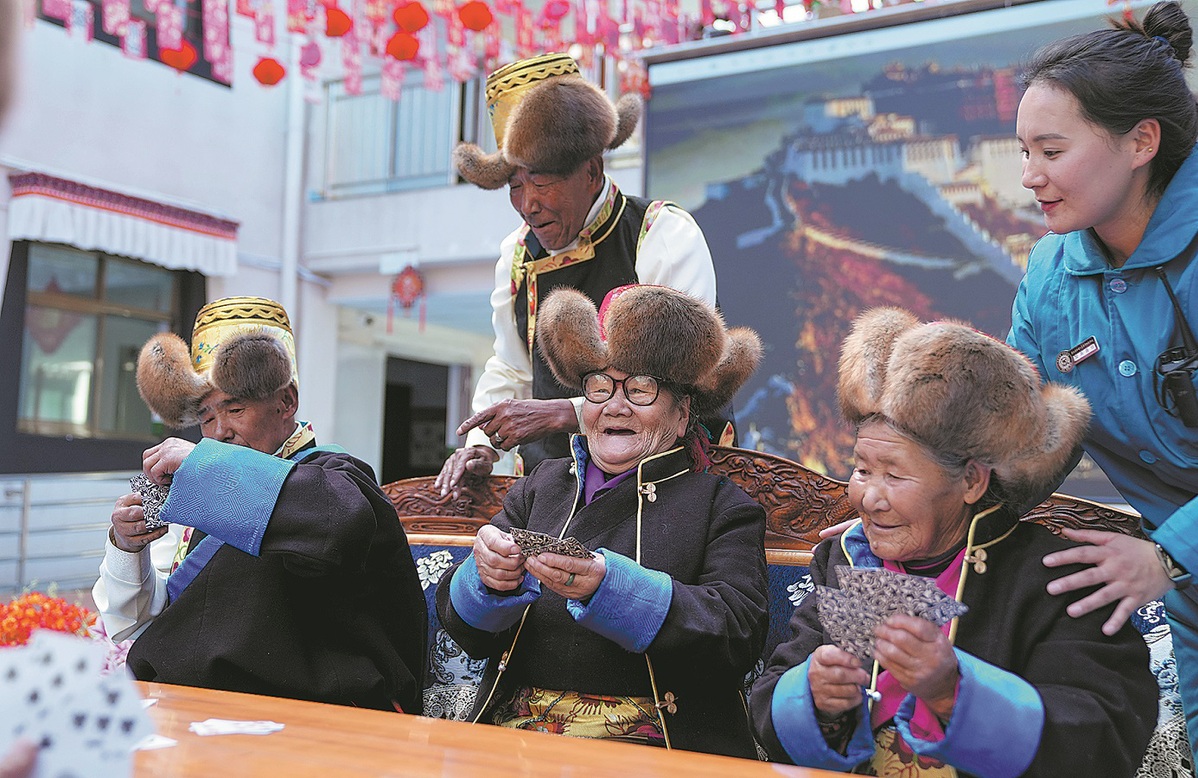
Seniors play cards at a care center in Lhokha city, Xizang autonomous region, on March 25. The region has expanded elderly care services and increased the coverage of basic medical insurance to above 95 percent. JIGME DORJE/XINHUA
Foreign experts and scholars praised the Xizang autonomous region's achievements in development since its peaceful liberation 75 years ago at a symposium held in the regional capital Lhasa on Saturday.
As an important event marking the historical milestone, the international academic symposium brought together domestic and overseas experts, scholars and researchers to review Xizang's 75-year journey and discuss valuable experiences in regional development in the new era.
Michael Alan Crook, a guest speaker at the symposium and cofounder of the Western Academy of Beijing, offered his thoughts on the region's development based on decades of investigation and the experience of his family in Tibetan areas spanning three generations.
Crook categorized Xizang's major transformations in three areas: health, education and life expectancy.
He added there has been infrastructure that respects nature, and the preservation of traditional Tibetan culture. "These are the true achievements of these 75 years," said Crook, who also serves as chairman of the International Committee for the Promotion of Chinese Industrial Cooperatives.
He said his grandparents witnessed people suffering without medical treatment in Xizang when they visited the region in the 1930s, and many died from even minor diseases because of a lack of timely medical intervention.
"I now see modern hospitals, community health centers, and trained doctors reaching every county and township. Vaccination programs, maternal care and treatment for chronic diseases are routine," he said.
As a result, life expectancy in Xizang has risen from just over 35 in the 1950s to more than 72 today, he said, adding that such progress is more than just statistics.
"That is a grandmother watching her grandchild grow up. That is a father living to see his daughter become a doctor. And that is the most profound change any society can achieve," he added.
Experts and scholars also shared their views on the ecological conservation efforts in the plateau region.
Krishna Prasad Oli, a former Nepalese ambassador to China and an expert in ecology, delivered a speech on how Asian philosophical traditions contribute to ecological civilization alongside modern environmental discourse.
"Ecological civilization is not merely a policy framework or a development model. It is a way of being, a reorientation of human consciousness that recognizes the profound interdependence between humanity and nature," Oli said.
Speaking on governance, Oli said the Chinese government and the Xizang autonomous regional government have adopted a model of ecological civilization by promulgating and enforcing strict environmental protection policies and conservation regulations, carrying out large-scale greening initiatives, and expanding clean energy development in Xizang.
"It has followed a people-centered approach to development, prioritizing eco-environmental protection, innovation, coordination and green development," he said.