
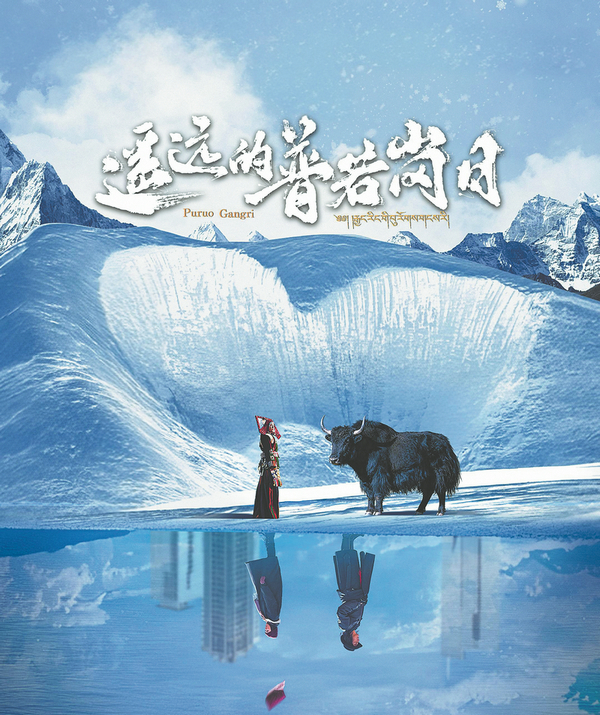
A poster for the film Puruo Gangri. CHINA DAILY
A film salutes grassroots officials enduring extreme altitudes, separation, and sacrifice while transforming lives in Xizang's remote regions, Xu Fan reports.
When filmmaker Cai Yu ventured deep into Tsonyi county in the Xizang autonomous region — the country's highest county with an average altitude exceeding 5,000 meters — to shoot a documentary in 2015, one interview stayed with him long after filming ended.
The subject was Deng Jiping, a local government official originally from Sichuan province, who has worked in Xizang for more than two decades, much of that time living apart from his family. Deng recalled a painful moment when his wife once told him he was an unqualified father. Their son, she said, jokingly called him "phone dad", because Deng could return home to see his family only a few times each year.
Through more interviews with officials who have overcome challenges ranging from altitude sickness, to isolation and years of separation from loved ones, Cai was moved by their dedication. Over the next four years, he developed a script inspired by their experiences. The result was Puruo Gangri, a feature-length movie that was released on the Chinese mainland in December.
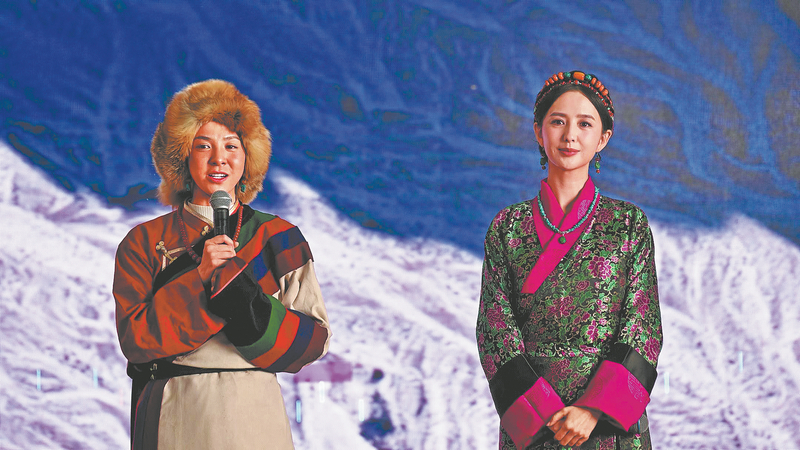
A scene from the Xizang-set film Puruo Gangri features actress Tong Liya (right), tourism ambassador for Nagchu, and actress Tang Shiyi, who plays the protagonist — a cadre in Tsonyi county committed to improving living conditions and boosting the local economy. CHINA DAILY
Adapted from the real-life stories of grassroots officials in Xizang, the film follows Tong Xiaofan, a recent university graduate who leaves her hometown to work as a cadre in Tsonyi county. In her early years, unable to endure the harsh environment and profound loneliness of the remote area, she manages to get transferred to Lhasa by passing a civil service examination.
However, after realizing her deep connection to the land, Tong chooses to return to Tsonyi and dedicates herself to helping local herders increase their household income. Aided by a local official, an ethnic Tibetan who later falls in love with her, Tong works alongside fellow cadres to improve their living conditions. Their efforts ultimately lead to the relocation of the herders from the extreme high altitude of over 5,000 meters to a lower area at around 3,600 meters.
For Cai, what first drew him to the vast landscape of northern Xizang was its raw, untouched nature and profound sense of mystery.
"Tens of millions of years ago, the northern Tibetan Plateau rose from the sea, and much of this terrain has barely been touched by humans. That's what makes it so compelling — to walk here is to feel as though you are leaving the very first footprints, almost like stepping onto the moon," says Cai.
After discovering that the plateau had rarely been featured in films — apart from some scientific footage — Cai envisioned using the cinematic lens to unveil its mysteries. His dream was realized in 2016, when he served as executive producer alongside director Rao Zijun, leading a crew of 48 members on a 3,500-kilometer journey to shoot the documentary Hidden Land in Northern Tibet.
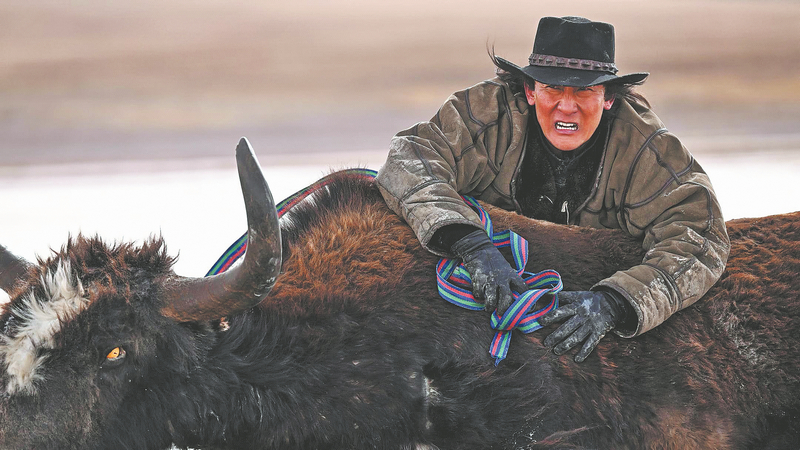
Tibetan actor Ngawang Rinchen portrays a local cadre who sacrifices his life while rescuing a yak that has fallen into an icy river. CHINA DAILY
Three years later, as efforts intensified nationwide to improve living conditions and protect the local ecosystem, the first batch of 2,900 residents from Tsonyi county was relocated nearly 1,000 km south to the north bank of the Yarlung Zangbo River, at an altitude of 3,600 meters, which is lower than Tsonyi's average altitude of around 5,000 meters.
When the relocation campaign drew to a close in 2021, Cai revisited the county for follow-up interviews. These encounters inspired him to codirect the 95-minute film Puruo Gangri with Zhao Hantang, known for the 2017 Xizang-set film Seventy-Seven Days.
More interviews followed, each adding moving moments to the project. One particularly striking interview took place in April 2023. Zhang Kunyuan, a government official who assisted Cai during fieldwork, showed him an old photo taken 11 years earlier when Zhang had just begun working in Tsonyi.
The young man in the picture had thick, black hair. Today, he is bald, with eyes red and swollen from years of living in harsh conditions. This dramatic change in appearance prompted the director to create a plotline for a major character in the film.

Tang plays Tong Xiaofan, the protagonist who develops a deep emotional bond with Xizang. CHINA DAILY
After extensive preparation, the film was shot between February and June last year. The crew traveled more than 3,000 km across remote locations. The team, divided into two groups, consisted of around 230 people, with one-third of the budget allocated to ensure safety while filming in extremely high-altitude and uninhabited areas.
One of the most challenging scenes features the male lead plunging into an icy lake to rescue a stray yak in an effort to protect a local herder's property. The plot was conceived by actor Ngawang Rinchen, who insisted on shooting the scene in a real icy river located at an altitude of 5,300 meters — where the temperature plummeted to — 27 C amid strong winds.
"In the high plateau area, hypothermia can cause your hands to lose control quickly, and put lives at risk. We once suggested the actor return to Lhasa to shoot in a relatively safer environment, but he insisted on completing the scene in Tsonyi for a more realistic effect," recalls Cai, expressing his admiration.
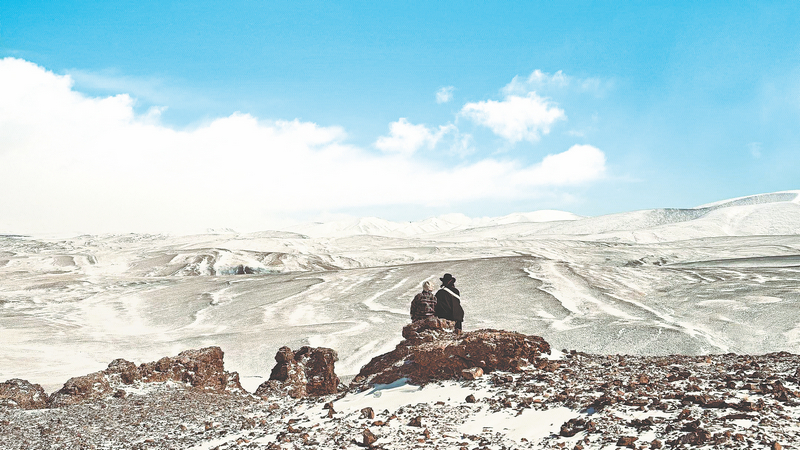
Tong, the protagonist, and Lobsang, a Tibetan cadre, sit together admiring the grandeur of the Puruo Gangri Glacier. CHINA DAILY
For the director, the film is not only a tribute to the grassroots cadres who have dedicated themselves to improving local living conditions, but also a reflective journey exploring humanity's relationship with nature.
"In the vast timeline that has shaped the Puruo Gangri Glacier, all of us — whether behind the camera or in front of it — are but a grain in the sea compared to its 700,000-year history," says Cai. He hopes the film can prompt deeper reflection on where humanity has come from and where it is headed.