
In Pumaqangtang, water boils at 60 C, oxygen is a luxury and the landscape is an almost permanent white sheet of ice. At 5,373 meters above sea level in the Xizang autonomous region on the border with Bhutan, it is home to the highest police border station in China.
The brutal, unforgiving conditions in Pumaqangtang have given it the ominous moniker of being a "forbidden zone for life".
But for Wu Hui, 27, as she graduated from a police training academy, it was the only place she wanted to be.
"Don't you want to push your limits?" she asked her fellow graduates."Don't you think it would be cool to work at the roof of the world?"
Her resolve was infectious. In February 2024, Wu convinced two other recent graduates — Li Tianjiao, 29, and Li Hongyan, 25 — to volunteer for the remote outpost. In doing so, they made history as the first female police officers to serve at the station since its founding in 2012.
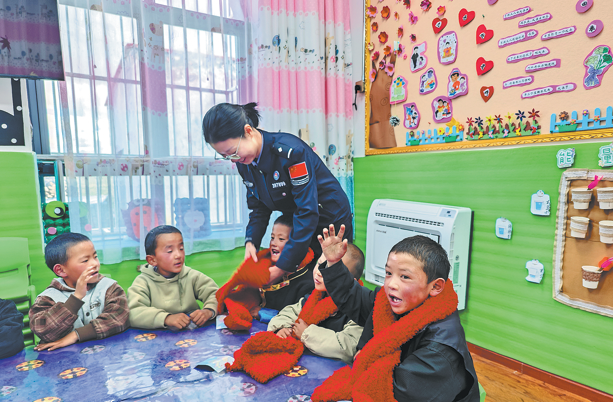
Wu Hui gives gifts to children at a village kindergarten in July. CHINA DAILY
Brutal welcome
The reality of their decision hit before they even unpacked. As Li Hongyan stepped out of the patrol car on her arrival at the border station in Pumaqangtang, her chest tightened in the thin air.
She looked up to see the station instructor, Nyima Gyaltsen, waiting to greet them. He was gaunt, recovering from a recent illness, his hands shaking with exhaustion as he poured them hot tea.
"My initial thoughts were 'This place is truly brutal'," Li said.
The statistics back her up: average temperatures stay below — 7 C, and oxygen levels are less than 40 percent of those at sea level. For the 20 officers and 6 auxiliary staff stationed there, the price of service is physical. Insomnia is constant. Hair falls out in clumps. Memory becomes "fuzzy" as the brain starves for oxygen.
"We joke about going scatterbrained," said Li Tianjiao.
"Whenever we take photos, we have to ask the photographer to airbrush a bit more hair onto our heads. It's a quiet reminder of what we leave behind here."
The station oversees 1,500 square kilometers of treacherous borderland, including the "internet-famous" Gangbu Glacier. In March 2024, the trio faced their first real test: a midnight rescue mission for tourists trapped in glacial swampland.
Under the guidance of their mentor, Gao Hui, they learned that the glacier hides deadly traps. In winter, the ground is solid; in spring, it becomes a frozen quagmire where one wrong step could be fatal.
"I was terrified," Wu said of the mission. "Our headlights were the only sliver of light in the endless darkness. When we found them, they were shivering uncontrollably. One girl just threw her arms around me and cried. I realized then — this isn't just a job. It's a race against death."
The mission brought back the haunting memory of 2018, when a tourist went missing in — 40 C weather. Despite a four-day search led by the then-director Sonam Daje, the individual was found frozen to death in a riverbed. It was a tragedy that ensures the officers never take a rescue call lightly.
Second home
Beyond the high-stakes rescues, the women have woven themselves into the fabric of the local community, serving six villages and a permanent population of 1,156 residents. To them, Pumaqangtang isn't just a workplace; it's a second home.
Despite the "swollen face and purple lips" that Wu has to hide from her mother during calls to spare her worry, the women have found a rhythm in the cold.
They don't just patrol; they belong. Wu Hui delivers ID cards to remote nomadic camps where she is greeted with steaming butter tea. Li Hongyan spends her free time teaching art at the local school, painting "the summer of her imagination" for children who live in a land where trees cannot grow.
To maintain their mental health, they utilize the station's small luxuries: a pool table, a movie room and a karaoke lounge.
They tend to a vegetable greenhouse and forage for mushrooms during the fleeting, beautiful summer months.
For Li Hongyan, the motivation is simple. Growing up in a border town in Yunnan province, she watched soldiers guard her home. Now, she is the one standing watch.
"I want to serve until my body can no longer keep up," she said. "Others were beacons for me. Now, I want to be a beacon for someone else."