
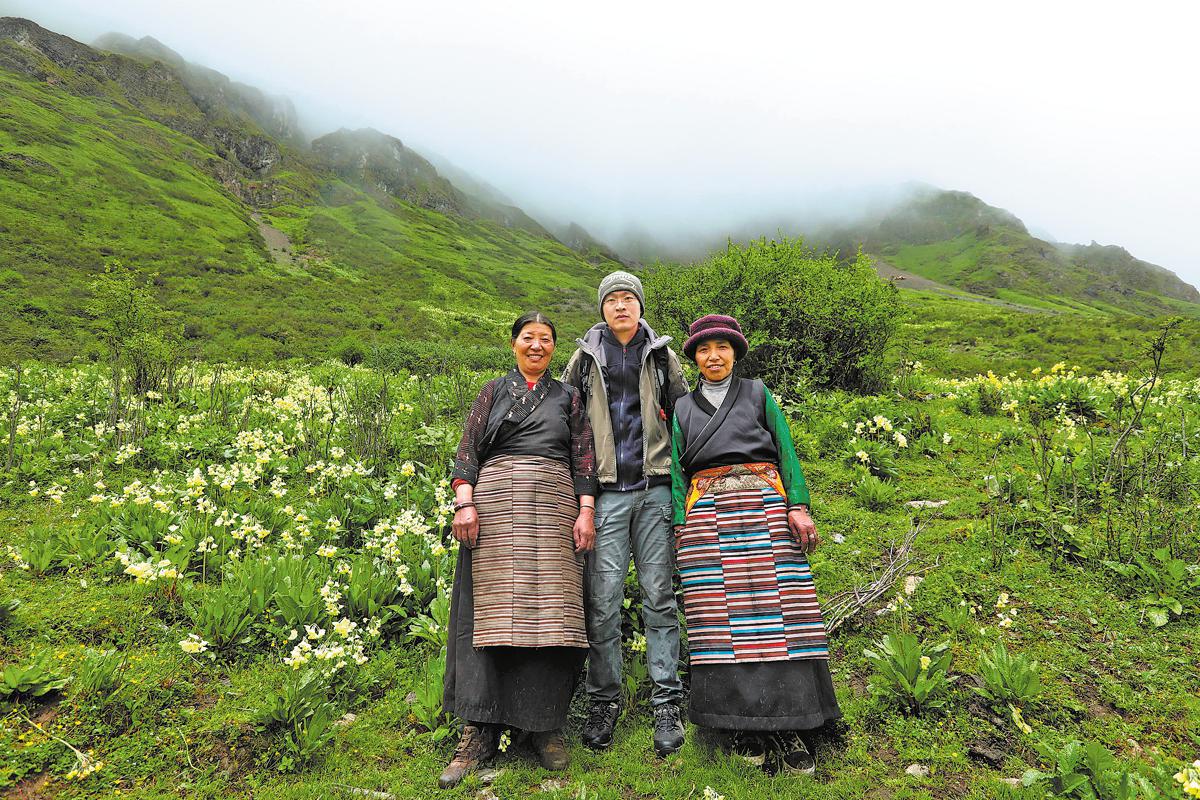
Niu Xue poses with Drolkar (right) and her sister Yangzom in Yumai township in Lhokha city, Xizang, in 2018. CHINA DAILY
Niu Xue, a college teacher in Wuhan, Hubei province, has visited the Xizang autonomous region at least once a year for the past 21 years, recording the region's changes with his camera and bringing the mysterious land closer to his students.
Having spent about 600 days in the region, Niu, 48, a professor from the School of Innovation and Design at Wuhan Textile University, has captured moments such as farmers hauling goods on wooden carts, travelers leaving handwritten travel tips on hostel walls, the cycling craze on Highway 318, and newlyweds posing in front of the Potala Palace in Lhasa.
Each trip he spent more than 20 days there despite often getting altitude sickness. He believes it is his duty to document Tibetan culture.
For Niu, Xizang is more than a research project, instead, it's his spiritual home where he has resonated with and grown attached to local people.
One of his most impressive subjects is Drolkar, whose family has devoted 32 years to herding and guarding the remote border area in Yumai township, Lhokha city.
In July 2018, he visited Drolkar's house for the first time and captured footage of her making butter and cheese with her second daughter in a small wooden house at the summer pasture.
The second time he visited the family in 2023, taking a photo of Drolkar when she picked up a stone, placed it in the net of her slingshot, and hurled it forcefully across the river.
"It turned out that her yak had strayed to the opposite bank, and she needed to drive it back. I was lucky enough to capture that moment," Niu said.
Niu noticed that compared with 2018, she had aged significantly. Her eldest daughter helped her make butter, while her eldest son-in-law held their 1-year-old son and lulled him to sleep. Strings of cheese curd hung from the roof beams. These daily life scenes were all captured by Niu's camera.
This July, Niu met her for the third time with his students at a summer pasture. They documented the scenes of her daily labor together.
"Certain frames, colors and pieces of information in images combine to form specific emotions, converging into a unique visual language that ultimately communicates particular ideas," he said.
Shooting in Xizang is not only about surprises, but also thrills. In 2018, while climbing over and shooting at Tsari Mountain with an altitude of more than 5,000 meters, Niu was struck by hypothermia, hunger and altitude sickness, with no mobile phone signal. Relying only on survival instinct, he spent seven hours inching his way down through deep snow.
"I was on edge the whole time, afraid I might freeze to death before nightfall," he said. At last, when his boots touched softer ground, he saw his Tibetan guide Pema Gyaltsan waiting in a stone hut.
Upon seeing Niu, he went to cut some shrubs and rhododendron branches nearby, poured oil on them to light a fire, and kept fanning it with a portable hand blower. The burning flames warmed the stone hut. A small pot of water, which took great effort to boil because of the altitude, spread warmth throughout Niu's body.
For Niu, every journey to Xizang is not only about recording change but also about reaffirming a truth: friendship and respect can transcend distance, culture and language.
Niu has used his photos from Xizang in his course, Photography Basics, which was rated a "national excellent online open course" in 2018 and included in the first batch of national first-class undergraduate courses in 2020. Some 860,000 students across China have taken the course through online and offline channels, learning from a firsthand view of Xizang's landscapes and culture.
Deng Jiayi, a student, visited Lhasa and Lhokha with Niu in July. "I want to record the unique rhythm of Lhasa between tradition and modernity — not only the devout scripture chanting on pilgrim circuits around Barkhor Bazaar, but also the leisurely conversations in cafes; there are elderly people dressed in Tibetan clothes, as well as young people playing on skateboards," she said.
She said that the grandeur of Xizang lies not only in its scenery, but more in its people. "It is the people living here who, in different ways, collectively define the depth and warmth of this land," she added.
She said Niu respects and delves deeply into the cultures of different ethnic groups, forging profound friendships with local communities. "He always said tolerance and appreciation for cultural diversity facilitate our better communication with the world," Deng said.
Xie Sheng, another student, shot a documentary about the Ongkor Festival — which is celebrated by local farmers praying for good harvests of their crops — with Niu's guidance.
"The documentary not only showcases grand rituals and traditions but also focuses on the 'human' aspect during the festival. What I aim to express is the vitality of traditional culture in the present day, how it unites communities, and how it radiates new vitality through dialogue with modern life," he said, adding that this experience also made him reflect on the essence of life and gain inner tranquility.
He said Niu always reminds him not to be a superficial "tourist" but to approach with respect and patience, "truly immersing myself in the local life and rhythm to feel it — only then can works carry warmth".
Liu Xueru contributed to this story.