
The formation of Cha-Bonism mainly owed to a prestigious personality called Shenrab Miwo who was believed the patriarch of the religion in lots of Tibetan historical literature. The Mirror Illuminating the Royal Genealogies: Tibetan Buddhist Historiography has a detailed record: “The patriarch was called Shenrab Miwo, born in Ermolhingren, Arabes. Many scriptures of the Bon religion, such as the Eight-Volume Kangqinbogyi and so on, were translated in Shangshung and prevailed in Tubo. The Bon religion can fall into nine sects, four sects in the Cause Bon Religion and five in the Effect Bon Religion. The teachings of the Effect Bon Religion are to enter the highest stage, the Yungdrung Great Perfection, through cultivation. The four sects of Cause Bon Religion are Namshen Beitogyain sect, Chinshen Beicungyain sect, Chashen Junshiyain sect and Dushen Cunchegyain sects. The Namshen Beitogyain Sect was mainly engaged in calling for good fortune, increasing prosperity and praying for the gods to cure the sick; the Chinshen Beicungyain Sect was adept at death and funeral rituals, such as placing funerary vessels and sacrificial offerings, performing rituals for house and tomb construction and eliminating all disasters; the Chashen Jushiyain Sect usually practiced divination to forecast good or ill luck, and tell right from wrong; and the Dushen Cunchegyain Sect was involved in the rituals of dispelling sufferings for the living, keeping a coffin with corpse in a temporary shelter before burial, protecting the children from harm from ghosts, practising divination by astrology, and capturing and driving off demons and ghosts. All the sects applied tambourines or a cymbal when practising the rituals.” The record elaborates the life of the founder Shenrab Miwo, the founding process and the principal contents of the Yungdrung Bonism.
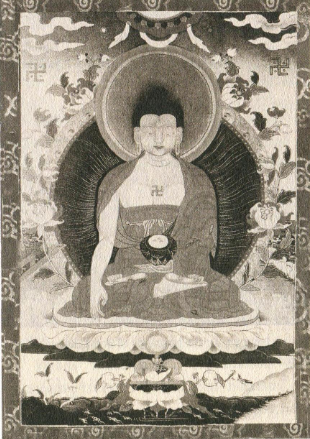
The Thangka of Shenrab Miwo, the founder of Bon Religion.
As for the doctrines of the Bon religion at the Cha-Bonism period, in his book on the Integration of Politics and Religion in Tibet, Tibetan scholar Dungkal Losang Trinley made a summary: the new-style Bon religion was called Namshen which denied the view on prelife and afterlife while admitted the existence of gods and ghosts. It embraces the view that gods protect the life of human beings when they are alive, while ghosts not only control the life of human beings but also take their souls away when they died, and continue harming the families and offspring of the deceased. So, people should worship gods who protect people and eliminate ghosts who harm people. According to the records in Legend of Yeshechogye, every autumn there would be a religious ritual called “god sacrifices of the Bon religion”, in which 3,000 of male yaks, sheep, goats and so on respectively would be slaughtered, along with 1,000 of female yaks, sheep, goats and so on respectively be dismembered, to give flesh and blood as offerings. In spring, there would be the sacrifice to dismember does. Four does would be butchered with their hoofs broken beforehand as the offerings. In summer, there would be the sacrifice to commemorate the forefathers of the Bon religion, in which wood and grain would be burned with the smoke rising to the sky. One should offer alms to redeem his life when he suffered from sickness with the offerings to gods based on his economic condition. After one's death, domesticated animals also would be slain as sacrifice to capture devils or ghosts. In addition, there were other rituals such as praying for blessing, exorcising evils to avert a misfortune, redemption, atonement, and divination, etc.

The ancient cave for the practicing of Bon Religion believers in Jinchuan county, Aba prefecture, Sichuan province.
The complicated religious rituals above indicate that Cha-Bonism emphasized sacrificing animals to pray for blessings and grace of gods and spirits. We can even say that all religious activities at that time were held with “sacrifice” as the core.